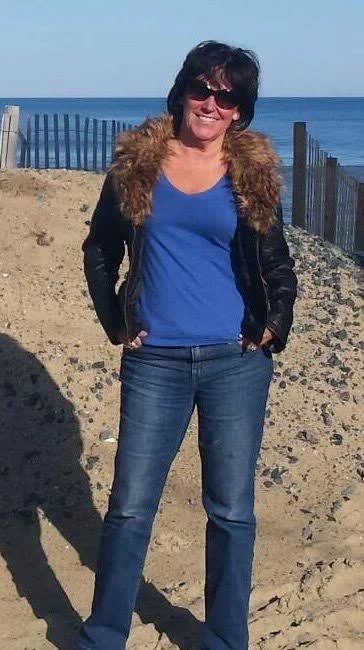
ABOUT THE AUTHOR
Raised a military dependent, TL Cole traveled much of her formidable years from North Carolina to East Asia attending sixteen schools before coming home to North Carolina for her senior year. After her first marriage, she received her degree in English Education and her MA in English Literature from North Carolina State University with a concentration in creative writing under Lee Smith and Film under Dr. Joseph Gomez. By the end of her career as an English teacher of thirty years, and she had married and divorce for the second time.
She retired after moving to be with her ailing father in the Outer Banks. After he passed, she just stayed and married for the last time to an owner of a small business. They travel as much as they can. She has no children, just her dog, Riley.
The North Carolina Outer Banks, a 200-mile stretch of barrier islands buffering the mainland from the powerful Atlantic Ocean, occupies much space in my mind. We call it the Sandbar because that’s what it is. It is here where my husband and I make our home on a street that was long ago part of a fishing village that became the town of Kill Devil Hills not far from historic Manteo, the place of the first failed American colony. Having retired to this stable, coastal existence suits me, providing stability which is in contrast to the continual motion of a former military “brat.” My mother navigated our relocations through three overseas deployments of my father to the Philippines which was no small feat for a country girl. Although much of what I write here is fiction, the motive behind this story is an attempt to connect with her. I found that it required a much wider lens. The scaffold of this story is based on four generations of women. It is not a memoir. It is not a history. It is a piece of timely fiction which exposes societal influences that challenge us, bend us, or break us.
Much of my adult life has been spent trying to come to terms with the woman who nurtured me, unwillingly at times, through my formidable years. Her physical beauty and stubbornness made her my hero and my nemesis. Many of my first memories of my mother formed at and around, not just the Outer Banks, but the Inner Banks of Gates County and Hartford County. Although fiction, some readers may find this story difficult or uncomfortable. I accept that without apology.
It’s really of no mystery as to why the sights, the sounds, the smells of various places burrow so deeply into a child’s soul. This sliver of sand has become my frame, my point of reference, my lens through which I have come to know the world. It was through family visits to this remarkable place that I began to unravel the confusions and mysteries of the lives of women from my past.
I became tethered to the salty smell of my grandfather’s ocean front cottage. If we were allowed to stay there every so often, we agreed to prepare seven cottages for the next week of renters. The rhythm of distant crashing waves mixed with the white bed sheets flapping in the breeze from the clothes line created a syncopation I loved. It comforted me. I can still feel the sting from the sunburn on my pink skin and the scent of Coppertone. I noticed those darkened freckles that later blemished the bridge of my nose when I glanced at the mirror while running out the front door of our cottage. Most are gone and those that remain have graduated to age spots.
Growing up, I remember scattered days at my grandfather's cottages, the voices of my brothers at the shoreline embroiled in arguments while trying to maneuver their tangled hooks and fishing lines, my father piking orders for them to calm down, and the side scuttling sand crabs at my feet in a desperate act of domestication, retreating to their homes beneath the clothes line—these are the events that structured a consistency of place.
My grandfather on my daddy's side was a no-nonsense, hard-working builder who became pretty well-known through the burgeoning tourist real estate at the beach. Of the seven tiny cinder block rental cottages situated on the dunes of the Atlantic, only five remain now. These beach days I spent there were not without cost. When we visited, we were the housekeeping crew. We had to make sure clean linens and towels were available, and each cottage was cleaned and set up with all necessary sundries in place. There was no free ride with my grandfather. Daddy, sporting his swimsuit recently bought in Hawaii on a layover, made it his job as a man to surf fish with his sons for dinner, so the bulk of preparation for next week’s renters fell upon my fiery-tempered mama and me. Benny and Ella provided an extensive list of chores that had to be done in each of the cottages after all the renters checked out. It read: "Before Leaving, 1) Put trash in bin, 2) Rolls of toilet paper in every cottage, 3) Wash any dishes, 4) Pick up trash and put in outside bin, 5) Wash and dry all the sheets by mid-afternoon and make beds, 6) Clean the bathrooms, and sweep out all the sand from the floors, 7) Lock it when you leave and put the key on window sill. Check-ins are at 3 o’clock. "
My mother was always irritated by Pops Benney’s “To-Do” list because most of the work fell upon her, but he had always been kind to her, so she wanted to please him. She had the opposite feeling for Ella. My mother had a fierce work ethic,
plus, she had a talent for delegating. “Toni, girl,” she’d barked. “Go get your brothers, and y’all get those sheets off the line. Don’t let them touch the ground and watch out for the crabs, then bring in the sheets to our cottage so I can press ‘em. After they are ready, it is y'all's job to get them on all the beds in each cottage, make the sheets even on both sides and don’t forget the hospital corners—I’ll be checking behind you.” The mention of hospital corners still echo in my head. I hated them and in those days fitted sheets didn't exist so that would be six corners per bed.
Still, just this morning, I made my bed with hospital corner on the top sheet even though no one will see them. It's embedded in my DNA- a habit I just can’t break. My mother taught me, my grandmother taught her, and God only knows who taught my grandmother.
In retrospect all my grandparents, my mother, my father, and my oldest brother have passed, and my remaining estranged brother lives on the west coast. Now, when I take early morning walks along the shoreline with the sun rising from its saturated cradle, the yellowish orange glow of the dawn promises me of the possibilities of a new day, but to move forward requires retrospection. At this point in my years, time seems to move in a staccato. Sun downs come quicker and often the tasks of my day have been completed, and I am once more prepared to walk to the Sound's edge not sure if the water will be angry or calm. I will take either.
Here near the marshes, a gentle breeze stirs up brackish water, and the evening shadows bring a sense of comfort to the coming dark. I see atop a partially submerged rotting log, four turtles catching the last bit of warmth from the sun as it sets. They twist and balance to keep afloat, then their heads in unison notice me, and once again, my inevitable presence sends them sliding into the reeds which submerges the decaying tree limb for a moment, but it quickly bounces back up.
The reeds protect the land. We are grateful that they are there to fight off the daily tidal surges and angry waters of hurricanes. They submerge, they bend, they flap and twist in the wind. When the storm subsides, they return to the surface bent, but remarkably resilient. Down to the last detail, nature has choreographed a graceful movement, a ballet of sorts, and in that moment I know that I, too, am bent from storms. I am the tender reed, shaped and molded by those who went before me. I am "Everyman" and have become the sum of his or her parts—an ancestral hodgepodge if you will.
This novel is a fictional account of one woman’s desire to make sense of her life by looking back through four generations of her matriarchal line: Lucinda, the great grandmother, Bruce the grandmother and her daughter Melba Jane, and lastly her daughter Riley. It covers the entire 20th century and part of the 21st, the character and struggles of a Southern rural life. Many of the names of people and places are fictitious, although it may draw upon experiences from my own life, stories I have heard from friends and relatives, and some out of my imagination.
I showcase a few of my whimsical paintings reflective of some of my favorite artists. There are also some personal photographs. The chapters are vignettes of sorts, some with humor and some with sadness. There a few spirits sprinkled about that bring meaning or understanding to a particular event. It is the unraveling of a story many of us have come from.
AUTHOR’S NOTE TO READERS:
Contact us
Please feel free to get in touch should you have any questions, comments, or feedback to share.